Call Us Today! 1-855-835-7172|sales@intactgenomics.com

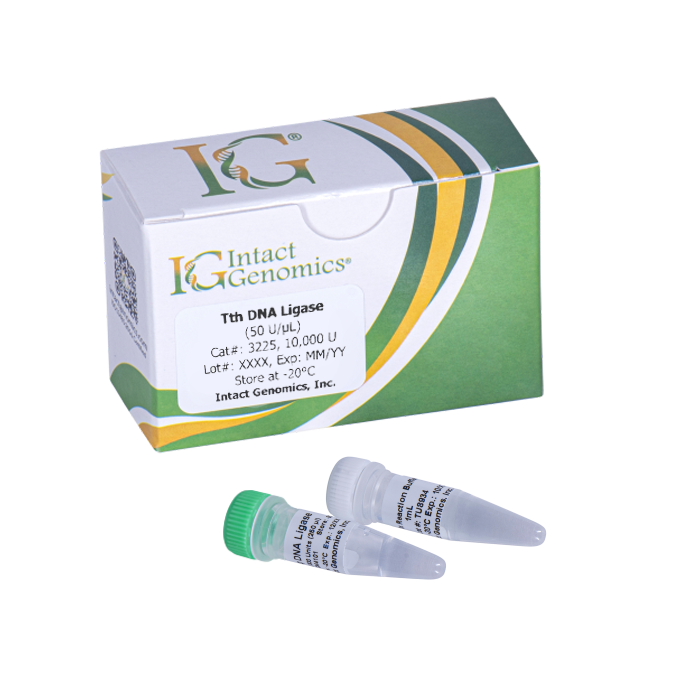
Tth DNA Ligase

Price range: $285.00 through $1,250.00

High-fidelity Thermus thermophilus (Tth) DNA Ligase from Intact Genomics delivers precise, thermostable ligation with excellent SNP discrimination and low background—ideal for LCR and mutation detection.

Custom formats, package sizes and bulk pricing are available upon request.


    1,000 units (20 µl) - $285.00 (Cat.# 3223 )

    10,000 units (200 µl) - $1250.00 (Cat.# 3225 )

Description

Intact Genomics (IG®) Tth DNA Ligase is an engineered high-fidelity DNA ligase. It catalyzes the formation of a phosphodiester bond in duplex DNA containing adjacent 5′-phosphoryl and 3′-hydroxyl termini, using NAD+ as a cofactor. Ligation occurs only when the oligonucleotides are perfectly paired to the complementary target DNA and have no gaps between them; allowing detection of single-base substitutions.

IG® high-fidelity Tth DNA Ligase is active at elevated temperatures (45°C–70°C), which gives it clear advantages over standard ligases such as T4 DNA Ligase. It is known for its high fidelity and strong mismatch discrimination, offering better specificity than mesophilic ligases, including Taq DNA Ligase2-3

Product Source:

             Tth DNA ligase is a derivatized enzyme that originated from Thermus thermophilus.

Species:
About seventy-seven (~77) kDa DNA ligase originating from Thermus thermophilus with enhanced fidelity.

Benefits:

  • Fast: Completes standard ligations in 5 minutes and most applications in under 30 minutes
  • Efficient and High-Fidelity: Delivers higher ligation fidelity than both Taq DNA ligase and T4 DNA ligase, resulting in more accurate and expected products
  • Thermostable: Maintains strong activity at elevated temperatures(45°C–70°C)
  • Highly Specific: Excellent for SNP discrimination and other precision applications
  • Reduces Background Noise: Improves assay accuracy and reliability
  • Buffer Tolerant: Less inhibition by analytes, enabling simplified workflows without buffer dilution, buffer exchange, or purification 

Applications:

  • Ligase Chain Reaction (LCR)
  • DNA mutation detection
  • Molecular diagnostics and pathogen detection
  • Padlock probe assays and rolling circle amplification (RCA)
  • High-temperature DNA ligation of complex or GC-rich templates
  • Synthetic biology applications

Product Components:

  • Enzyme: Tth DNA Ligase
  • Buffer: 10x Ligase Reaction Buffer with NAD+

Storage and Shipping Conditions:

  • Tth DNA Ligase: Store at -20 °C
  • 10x Ligase Reaction Buffer with NAD+: Store at -20 °C
  • Shipping condition: Ship on dry ice or with ice packs 

Quality Control:

Ligase Activity: Tth DNA Ligase can seal nicks in DNA plasmid at ≥74% efficiency and works equal to or better than competitor’s Tth Ligase. For sealing efficiency, IG’s T5 Exonuclease (product catalog #3236/8) digests virtually 100% of nicked DNA but leaves sealed DNA intact to quantify the amount of ligated product.

Nuclease Free: Nuclease activity is measured in a 10 μL reaction containing 0.5 μg of plasmid DNA and 0.5 μL of enzyme solution incubated for at least 14 hours at 37 °C.

Protein Purity: Proteins are evaluated by SDS-PAGE and quantified to be ≥95% pure.

Additional information

Units

1,000 units (20 µl), 10,000 units (200 µl)

General Guidelines:

  • Store products as directed. Both enzyme and buffer might degrade at warm temperatures.
  • Water, plastics and/or glassware used for reactions must be nuclease-free

Tth DNA Ligase may be used in many molecular-biology or commercial applications that require non-standard buffers, temperature, or processing.  The length of ligation may be increased to compensate for many non-standard applications to achieve good results. For improving ligated product yield, consider the following:

1) The enzyme has optimal activity from 60 °C to 65 °C, but it can be used  across a range of temperatures from 45 °C to 70 °C. Higher temperatures usually complete faster than lower temperatures.

2) The length of ligation may be extended for process convenience and large-scales (such as , 100 mL — 1L or more per ligation reaction, 2-16 hours), but usually will not exceed 16 hours, many reactions (small volumes) near completion in just 5 minutes following the procedure above.

3) Enzyme concentration may be adjusted to user’s needs. This process is scalable.  We supply custom sizes if more ligase is needed.

Standard Ligation Protocol:

1) Set-up the reaction as follows:

Reagent µL of sample
dsDNA X (up to 1 µg)
Tth DNA Ligase 2.0
10x Ligase Reaction Buffer 5.0
Nuclease-Free H2O Up to 50
Total Volume 50 µL

2) Incubate at 60 °C for 15 -30 minutes*.

3) (Optional) Heat inactivate at 95 °C for 15 minutes.

*Special applications may require adjusting assay temperature, including optimizing reaction temperature and ligation time. See General Guidelines for details.

References

  1. Barany, F. Genetic disease detection and DNA amplification using cloned thermostable ligase. Proceedings of the National Academy of Sciences 88, 189–193 (1991).
  2. Housby, J. N. & Southern, E. M. Fidelity of DNA ligation: a novel experimental approach based on the polymerisation of libraries of oligonucleotides. Nucleic Acids Res 26, 4259–4266 (1998).
  3. Luo, J. & Barany, F. Identification of Essential Residues in Thermus Thermophilus DNA Ligase. Nucleic Acids Res 24, 3079–3085 (1996).

Tth DNA Ligase Manual

Tth DNA Ligase MSDS

Certificate of Origin - Tth DNA Ligase

You may also like…

Title

Go to Top