Description
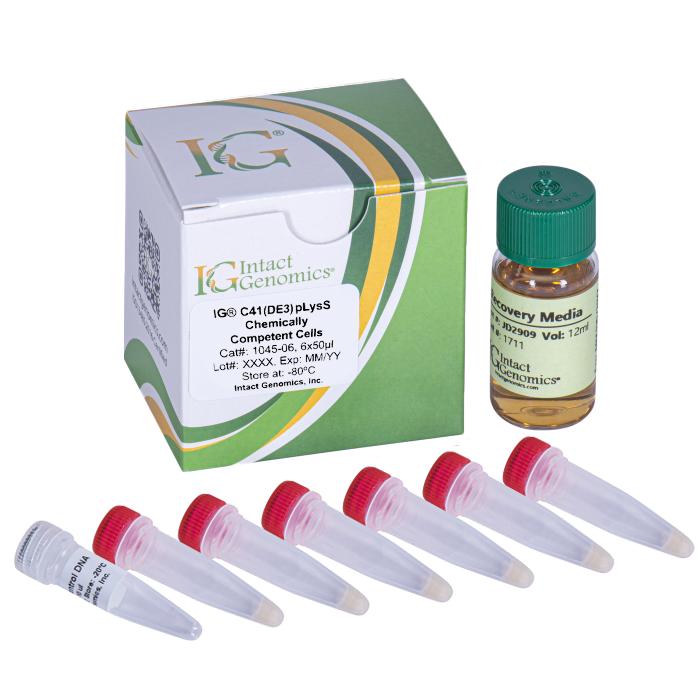
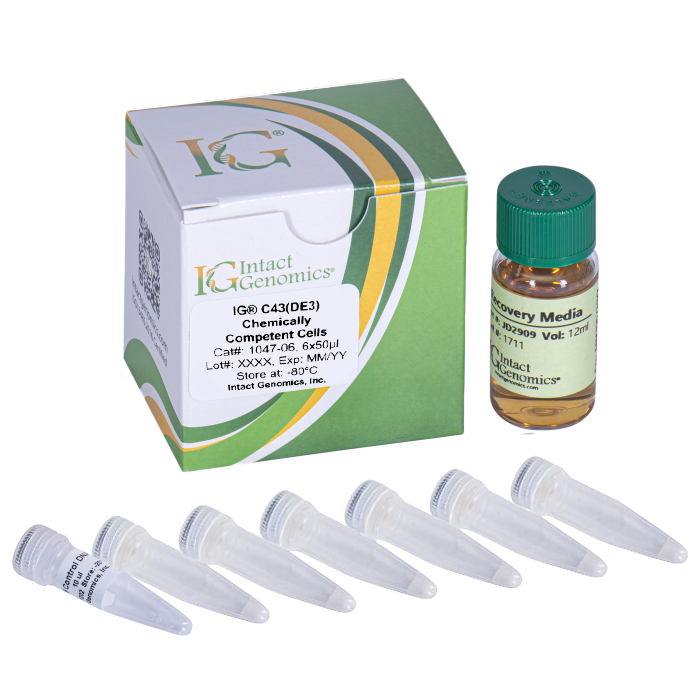
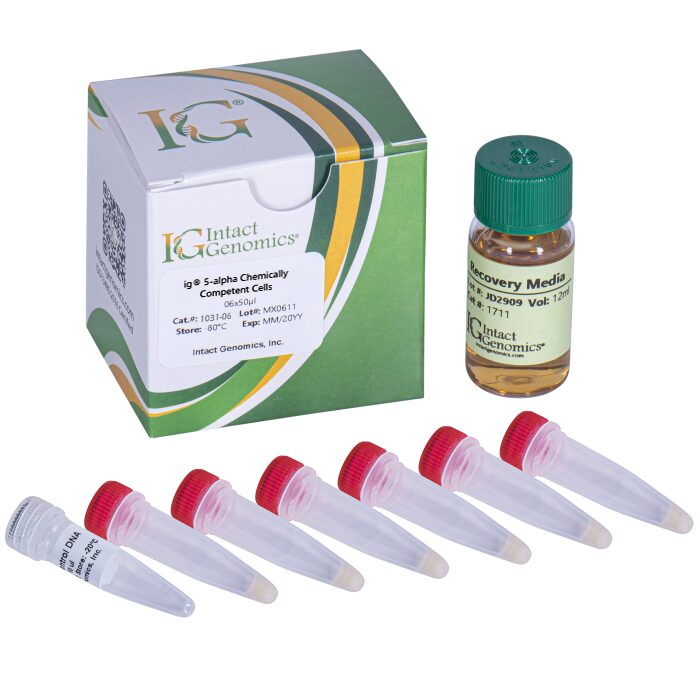
Intact Genomics (IG®) C41(DE3)pLysS Chemically Competent Cells are designed for transformation and routine recombinant protein expressed from a vector driven by an IPTG-inducible T7 promoter.
The C41(DE3) strain is a derivative of BL21(DE3) , was selected as survivor cells over-expressing the toxic oxoglutarate-malate carrier protein (OGCP), has lacI and other mutations, which prevent cell death associated with expression of many other recombinant toxic proteins. As a result, the C41(DE3)pLysS Chemically Competent Cells is highly effective in expressing toxic proteins from all organisms, including viruses, bacteria, yeasts, animals, plants, and mammals.
In addition, C41(DE3)pLysS strain also carries a chloramphenicol-resistant plasmid that encodes T7 lysozyme, which is a natural inhibitor of T7 RNA polymerase. Cells containing pLysS produce a small amount of T7 lysozyme. This strain is used to suppress basal expression of T7 RNA polymerase prior to induction, thus stabilizing recombinants encoding particularly toxic proteins. The effectiveness of C41(DE3)pLysS strain has been validated in >400 publications including all mutations were unveiled in genome sequencing.
Specifications:
Competent cell type: Chemically competent
Species: E. coli
Strain: C41(DE3)pLysS
Format: Tubes. Custom formats and package sizes available upon request.
Transformation efficiency: ≥ 1.0 x 10⁷ cfu/µg pUC19 DNA
Blue/white screening: No
Shipping condition: Dry ice
Reagents Needed for One Reaction:
IG® C41(DE3)pLysS Chemically Competent Cells: 50 µl
DNA (or pUC19 Control DNA, 10 pg/µl): 1 µl
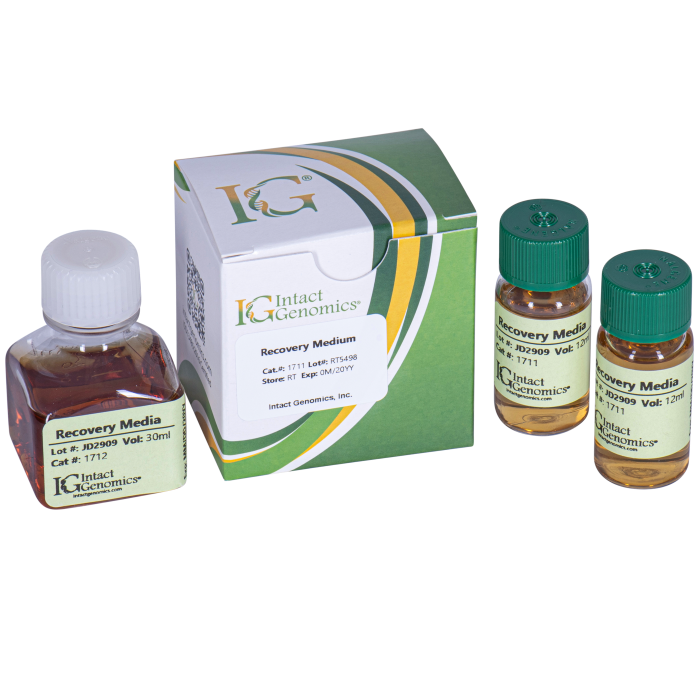
Recovery medium: 1 ml
Product Components and Recommended Storage Condition:
- IG® C41(DE3)pLysS Chemically Competent Cells: -80 °C
- DNA (pUC19, 10 pg/µl): -20 °C
- Recovery Medium: 4 °C
Genomic Features:
IG® C41(DE3)pLysS chemically competent cells have the following features:
- T7 Expression Strain
- Selected for expression of toxic proteins
- Suitable for expression of toxic genes
- ChlorR: chloramphenicol-resistant (12.5 ug/ml)
Quality Control:
Transformation efficiency is tested by using the pUC19 control DNA supplied with the kit and the high efficiency transformation protocol listed below. Transformation efficiency should be ≥ 1 x 10⁷ CFU/µg pUC19 DNA. Untransformed cells are tested for appropriate antibiotic sensitivity.065 1065-
General Guidelines:
Follow these guidelines when using C41(DE3)pLysS Chemically Competent Cells.
- Handle competent cells gently as they are highly sensitive to changes in temperature or mechanical lysis caused by pipetting.
- Thaw competent cells on ice, and transform cells immediately following thawing. After adding DNA, mix by tapping the tube gently. Do not mix cells by pipetting or vortexing.
1045 1045-06 1045-24
Calculation of Transformation Efficiency:
Transformation Efficiency (TE) is defined as the number of colony forming units (cfu) produced by transforming 1µg of plasmid into a given volume of competent cells.
TE = Colonies/µg/Dilution
Transform 1 µl of (10 pg/µl) pUC19 control plasmid into 50 µl of cells, add 950 µl of Recovery Medium. Dilute 10 µl of this in 990 µl of Recovery Medium and plate 50 µl. Count the colonies on the plate the next day. If you count 100 colonies, the TE is calculated as follows:
Colonies = 100
µg of DNA = 0.00001
Dilution = 50/1000 x 10/1000 = 0.0005
TE = 100/.00001/.0005 = 2.0×10¹⁰
High-Efficiency Transformation Protocol:
Use this procedure to transform IG® C41(DE3)pLysS Chemically Competent Cells.
These cells are designed for chemical transformation only. Do NOT use for electroporation. For electroporation transformation, use IG® C41(DE3)pLysS Electro Competent Cells.
1. DNA/Cell Mixture Preparation
1.1. Remove competent cells from the –80 °C freezer and thaw completely on wet ice for 10–15 minutes. Ensure that Recovery Medium is readily available at room temperature.
1.2. Aliquot 1–5 µl of DNA (1 pg–100 ng) into each pre-chilled microcentrifuge tube on ice.
1.3. Once thawed, gently add 50 µl of competent cells to each DNA tube while keeping on ice. Mix gently by tapping the tube 4–5 times. If using the 50 µl package size competent cells, add DNA directly to the tube and mix gently by tapping.
Do NOT pipette up and down or vortex. Harsh mixing can damage cells and reduce transformation efficiency.
2. Chemical Transformation
2.1. Incubate the DNA/cell mixture on ice for 30 minutes.
2.2. Heat shock the cells by placing the culture tubes in a 42 °C water bath for 45 seconds.
2.3. Immediately return the tubes back to ice for 2 minutes.
3. Cell Recovery
3.1. Aliquot 950 µl of room-temperature Recovery Medium (or other suitable medium) into each culture tube (17 mm × 100 mm), then transfer the heat-shocked cell/DNA mixture into the corresponding tube.
3.2. Incubate the tubes in a shaking incubator at 37 °C by shaking at 210 rpm for 1 hour.
4. Cell Plating
4.1. Plate 50–200 µl of each transformation onto pre-warmed LB agar plates containing the appropriate antibiotic(s). Spread evenly using a sterile spreader or autoclaved ColiRoller™ plating beads.
Before cell plating, the plates should be prewarmed to growth temperature (37 °C), and be free of condensation to prevent contamination and mixed colonies.
We recommend plating two different volumes to ensure well-isolated colonies on at least one plate.
4.2. Incubate the plates overnight (12-16 hr) at 37 °C.
Five Minute Transformation Protocol:
The following procedure results in only ~10% of the transformation efficiency as the protocol listed above.
- Remove competent cells from the -80 °C freezer and thaw in your hand.
- Aliquot 1-5 µl (1 pg-100 ng) of DNA to the microcentrifuge tubes. Do not pipette up and down or vortex to mix, this can harm cells and decrease transformation efficiency.
- Incubate the cells with DNA on ice for 2 minutes.
- After 2 minute ice incubation, heat shock the cells at 42 °C for 45 seconds.
- Transfer the tubes to ice for 2 minutes.
- Add 950 µl of room temperature Recovery Medium or any other medium of choice to each tube. Immediately spread 50 μl to 200 μl from each transformation on pre-warmed selection plates. We recommend plating two different volumes to ensure that at least one plate will have well-spaced colonies. For the pUC19 control, plate 50 μl on an LB plate containing 100 μg/ml ampicillin. Use sterilized spreader or autoclaved ColiRoller™ plating beads to spread evenly.
- Incubate the plates overnight (12-16 hr) at 37 °C.
References:
- Walker JE & Miroux B. US6361966.
- Miroux B, Walker JE. J Mol Biol. 1996 260:289-98.
- Dumon-Seignovert L, Cariot G, Vuillard L.Protein Expr Purif. 2004 37:203-6.
- Wagner S, et al. Proc Natl Acad Sci U S A. 2008. PMID: 18796603
- Kwon et. al. Sci Rep. 2015 5:16076
- Zhang et. al. Microb Cell Fact. 2015 14:142.
- Bajzert et. al. BMC Vet Res. 2022 18(1):409.