
Sub-Total: $0.00
Plant Transformation Using Agrobacterium tumefaciens
In nature, when a plant is wounded, Agrobacterium (found in soil frequently) can attach to the wound site and then proceeds to transform the cell it encounters. The wound site on the plant produces sugars and phenolic compounds, which not only signal the opportunity for pathogenesis but also aid in the induction of transcription of virulence genes. These virulence genes are located on the Tumor-inducing (Ti) plasmid. The Ti plasmid also contains transferred DNA (T-DNA). Agrobacterium can effectively transfer the T-DNA to the host plant and then cause 2 outcomes. First, they may code for a plant hormone that causes tumor growth, then they code for enzymes that produce opines, which are metabolized by agrobacterium. The result is a growth (called a “crown gall”) that is perfect for the agrobacterium to proliferate.
Scientists have discovered that they can use this natural ability of agrobacterium to insert genes of interest into the plant cells. The T-DNA region of the Ti plasmid that causes crown gall formation can be replaced with the genes of interest scientists want to study. Scientists have also discovered that different strains of Agrobacterium (i.e. GV3101, AGL-1, etc) work well for different types of plant species.
Plant Transformation Using Agrobacterium tumefaciens
There are several advantages for using agrobacterium mediated transformation over other transformation methods. These include(but not limited to):
- Reduction in transgene copy number
- Increased stability of intact introduced gene
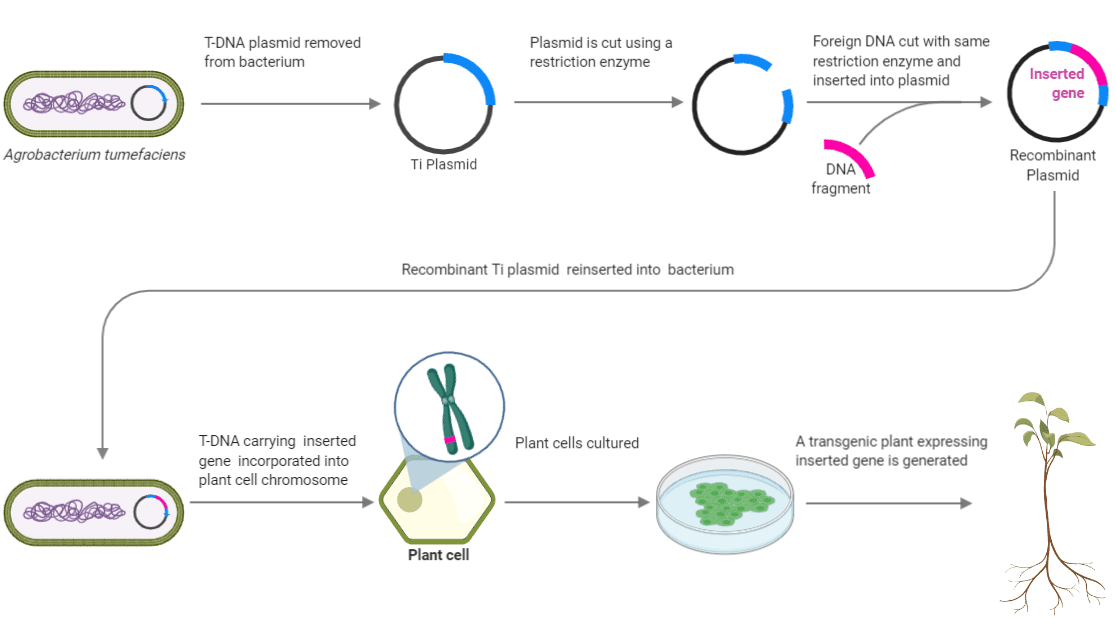
Agrobacterium Mediated Plant Transformation Process Outline
Below are the basic steps in the Agrobacterium-mediated Plant Transformation Process:
Isolate genes of interest from the source organism
Create a functional transgenic construct that includes:
a. The gene of interest
b. Expression Promoters
c. Codon optimization that increases protein production (if needed)
d. Marker genes to track gene expression in the host plant
Insert transgene into Ti plasmid
Insert T-DNA containing plasmid into Agrobacterium
Mix newly transformed agro cells with plant cells to allow transfer of the T-DNA into the plant chromosome
Regenerate the transformed cells into genetically modified plants
Test at various stages (greenhouse, field, lab) to ensure trait performance.
Agrobacterium Competent Cells
Using Propriety methods, Intact Genomics has developed and manufactured a variety of Agrobacterium chemically and electroporation competent cells with high efficiency. Agrobacterium strains include EHA105, LBA4404, GV3101 and AGL-1. All are useful for plant transgenic operations in a variety of species.
Custom Agrobacterium cells also available!
| Product | Efficiency | Application & Benefits |
|---|---|---|
| GV3101 Agrobacterium Chemically Competent Cells | ≥1.0 × 10⁵ | Transgenic operations of Arabidopsis thaliana, tobacco, corn, potato, and other plants. |
| GV3101 Agrobacterium ElectroCompetent Cells | ≥1.0 × 10⁷ | Transgenic operations of Arabidopsis thaliana, tobacco, corn, potato, and other plants. |
| AGL1 Agrobacterium Chemically Competent Cells | ≥1.0 × 10⁵ | Transgenic operations of Arabidopsis thaliana, maize, and other monocots. |
| AGL1 Agrobacterium ElectroCompetent Cells | ≥1.0 × 10⁷ | Transgenic operations of Arabidopsis thaliana, maize, and other monocots. |
| LBA4404 Agrobacterium Chemically Competent Cells | ≥1.0 × 10⁵ | Transgenic operations of tomatoes, tobacco, and other plants. |
| LBA4404 Agrobacterium ElectroCompetent Cells | ≥1.0 × 10⁷ | Transgenic operations of tomatoes, tobacco, and other plants. |
| EHA105 Agrobacterium Chemically Competent Cells | ≥1.0 × 10⁵ | Transgenic operations of rice, tobacco, and other plants. |
| EHA105 Agrobacterium ElectroCompetent Cells | ≥1.0 × 10⁷ | Transgenic operations of rice, tobacco, and other plants. |
| C58C1 Agrobacterium Chemically Competent Cells | ≥1.0 × 10⁵ | Transgenic operations involving potatoes, tobacco, and other plants. |
| C58C1 Agrobacterium ElectroCompetent Cells | ≥1.0 × 10⁷ | Transgenic operations involving potatoes, tobacco, and other plants. |
| Agrobacterium Chemically Competent Cells Combo Pack | Various | For applications requiring multiple Agrobacterium competent cell strains. |
| Agrobacterium ElectroCompetent Cells Combo Pack | Various | For applications requiring multiple Agrobacterium competent cell strains. |
| GV3101 (pSoup) Agrobacterium ElectroCompetent Cells | ≥1.0 × 10⁷ | Transgenic operations of Arabidopsis thaliana, tobacco, corn, potato, and other plants. |
| GV3101 (pSoup-p19) Agrobacterium ElectroCompetent Cells | ≥1.0 × 10⁷ | Transgenic operations of Arabidopsis thaliana, tobacco, corn, potato, and other plants. |
| AGL1 (pSoup) Agrobacterium ElectroCompetent Cells | ≥1.0 × 10⁷ | Transgenic operations of Arabidopsis thaliana, maize, and other monocots. |
| EHA105 (pSoup) Agrobacterium ElectroCompetent Cells | ≥1.0 × 10⁷ | Transgenic operations of rice, tobacco, and other plants. |
References
- Gelvin B. S. (2003) Agrobacterium-Mediated Plant Transformation: the Biology behind the Gene-Jockeying Tool. Microbiology and Molecular Biology Reviews 67(1): 16-37
- Jones D.H., Doherty A, and Wu H. (2005) Review of methodologies and a protocol for the Agrobacterium-mediated transformation of wheat. Plant Methods 1: 5
- Kumar K.K. , Maruthasalam S., Loganathan M., Sudhakar D. and Balasubramanian P. (2005) An Improved Agrobacterium-Mediated Transformation Protocol for Recalcitrant Elite Indica Rice Cultivars. Plant Molecular Biology Reporter 23: 67-73