Sub-Total: $0.00
Biotin Protein Ligase
Achieve precise, reliable protein labeling with IG® Biotin Protein Ligase (BirA). This ATP-dependent enzyme enables site-specific biotinylation of proteins containing AviTag™, BioTag, or BSP sequences, producing stable biotinylated proteins while helping preserve their structure and biological activity. Ideal for ELISA, protein immobilization, interaction studies, pull-down assays, affinity purification, and biosensor applications.
Custom formats, package sizes and bulk pricing are available upon request.
Price range: $145.00 through $485.00
Related products
-

mVenus Fluorescence Standard Kit
$486.00 Select options This product has multiple variants. The options may be chosen on the product page -
DsRed Fluorescence Standard Kit
$485.00 Select options This product has multiple variants. The options may be chosen on the product page -
TEV Protease
Price range: $115.00 through $1,875.00 Select options This product has multiple variants. The options may be chosen on the product page


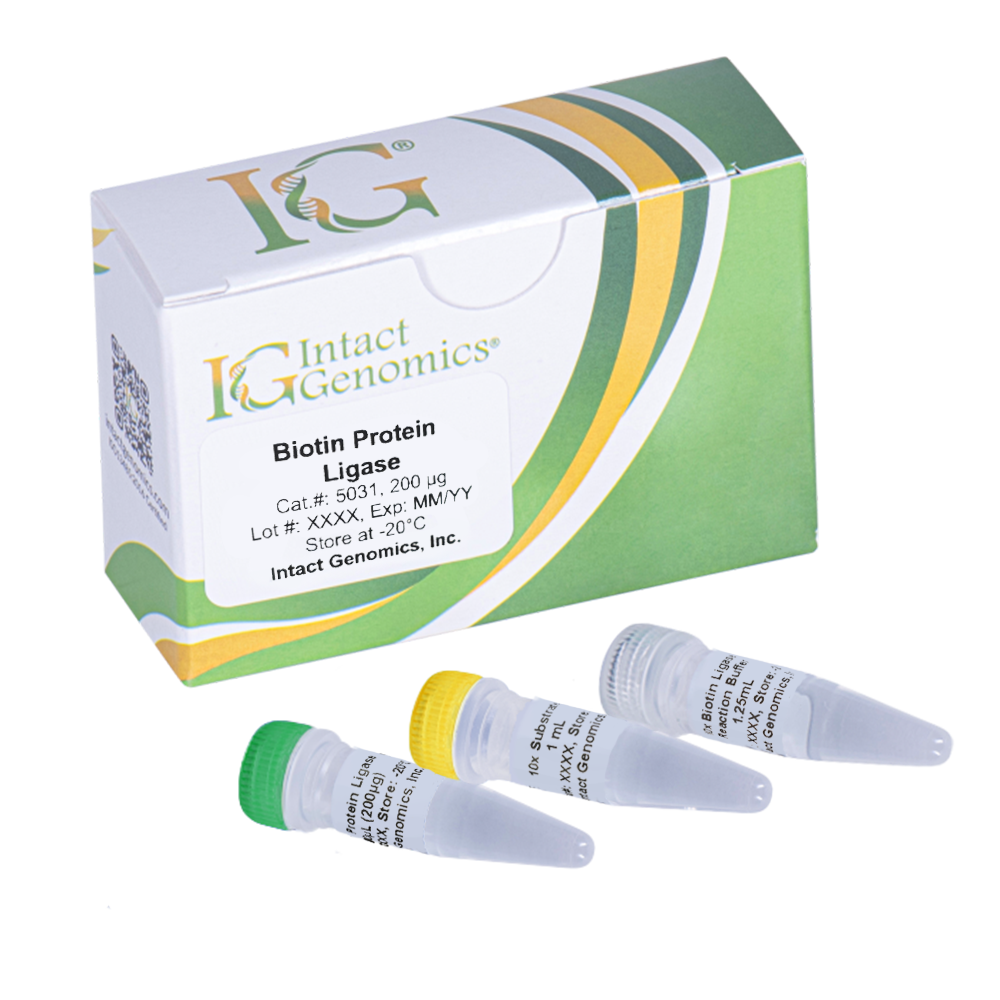
IG® Biotin Protein Ligase (BirA) is an ATP-dependent enzyme that catalyzes the site-specific covalent attachment of biotin to a specific lysine residue within a compatible biotin-acceptor peptide or protein. The reaction requires biotin, ATP, and magnesium and produces a stable biotinylated protein suitable for downstream detection, immobilization, purification, and interaction studies.
Recombinant Escherichia coli BirA is widely used to biotinylate proteins containing short biotin-acceptor sequences, including AviTag™ (GLNDIFEAQKIEWHE), BioTag (ALNDIFEAQKIEWHA), and BirA Substrate Peptide, or BSP (LHHILDAQKMVWNHR). These peptide sequences can be genetically fused to either the N-terminus or C-terminus of a target protein, enabling specific and controlled biotinylation by BirA.
Compared with nonspecific chemical labeling, BirA-mediated biotinylation provides site-specific modification at a defined lysine residue while helping preserve protein structure and biological activity. Biotinylated proteins bind streptavidin, avidin, or neutravidin with high affinity, supporting sensitive and reproducible applications in protein research, assay development, and biopharmaceutical studies.
Applications:
- In vitro biotinylation of AviTag-, BioTag-, or BSP-tagged proteins
- Preparation of biotinylated proteins for ELISA and other binding assays
- Protein immobilization on streptavidin-coated surfaces
- Protein–protein and protein–ligand interaction studies
- Preparation of biotinylated antigens, antibodies, receptors, and enzymes
- Affinity purification, pull-down assays, and biosensor applications
Benefits:
- Highly specific enzymatic biotinylation
- Controlled labeling at a defined lysine residue
- Helps preserve protein structure and activity
- Produces stable biotinylated proteins with strong streptavidin binding
- Suitable for a wide range of research and assay-development applications
Product Source:
Recombinant E.coli BirA is fused to the C-terminus of maltose-binding protein (MBP). A His-tag is located at the N-terminus of the fusion protein.
Shipping Conditions:
Ship on dry ice or with ice packs.
Specifications:
Purified E.coli BirA fusion protein with a molecular weight of 78 kDa.
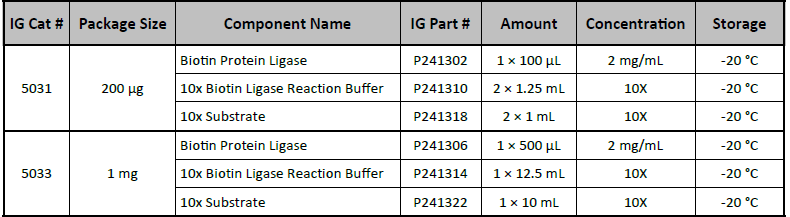
Components and Storage Temperature:
The following reagents are supplied with this product:
Quality Control:
1 unit of TEV protease will digest 2 µg of a fusion protein with a TEV site in 1 hour at 25ºC. Completeness is evaluated by SDS-PAGE.
General Guidelines:
The activity of the supplied Biotin Protein Ligase (BirA) is evaluated using a 20 kDa protein containing an N-terminal AviTag (GLNDIFEAQKIEWHE). Under the recommended reaction conditions, 1 µg of BirA catalyzes greater than 95% biotinylation of 100 µg of the tagged protein in a 50 µL reaction after incubation for 1 hour at 37 °C.
References:
- Fairhead M, Howarth M. Site-specific biotinylation of purified proteins using BirA. Methods Mol Biol. 2015;1266:171-84. doi: 10.1007/978-1-4939-2272-7_12. PMID: 25560075; PMCID: PMC4304673.
In vitro Biotinylation Protocol:
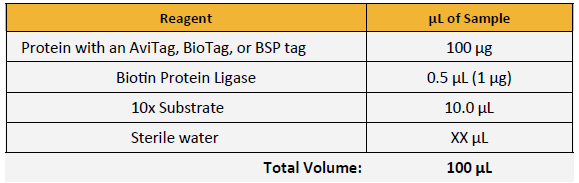
- Set up the reaction in a 1.5 mL microcentrifuge tube according to the table.
Note: The optimal mass ratio of biotin ligase to tagged protein may vary depending on the protein. The ratio described above is a recommended starting point. Test several ratios to determine the conditions that provide the desired level of biotinylation. - Incubate the mixture at for 1 hour at 37°C.
- Note: The reaction may be performed at 30 °C or lower; however, lower temperatures may reduce biotinylation efficiency. Some proteins may require a longer incubation time to achieve the desired level of biotinylation.
- Remove a sample containing 1 μg of protein from the reaction mixture and analyze it by SDS-PAGE. Include a non-biotinylated sample as a negative control. Biotinylation may cause a mobility shift in the tagged protein.
Alternatively, the biotinlyation can be assessed by incubating the reaction mixture with excess amount of immobilized streptavidin; biotinylated proteins will be removed by streptavidin and non-biotinylated proteins remain in the solution.