
Sub-Total: $0.00
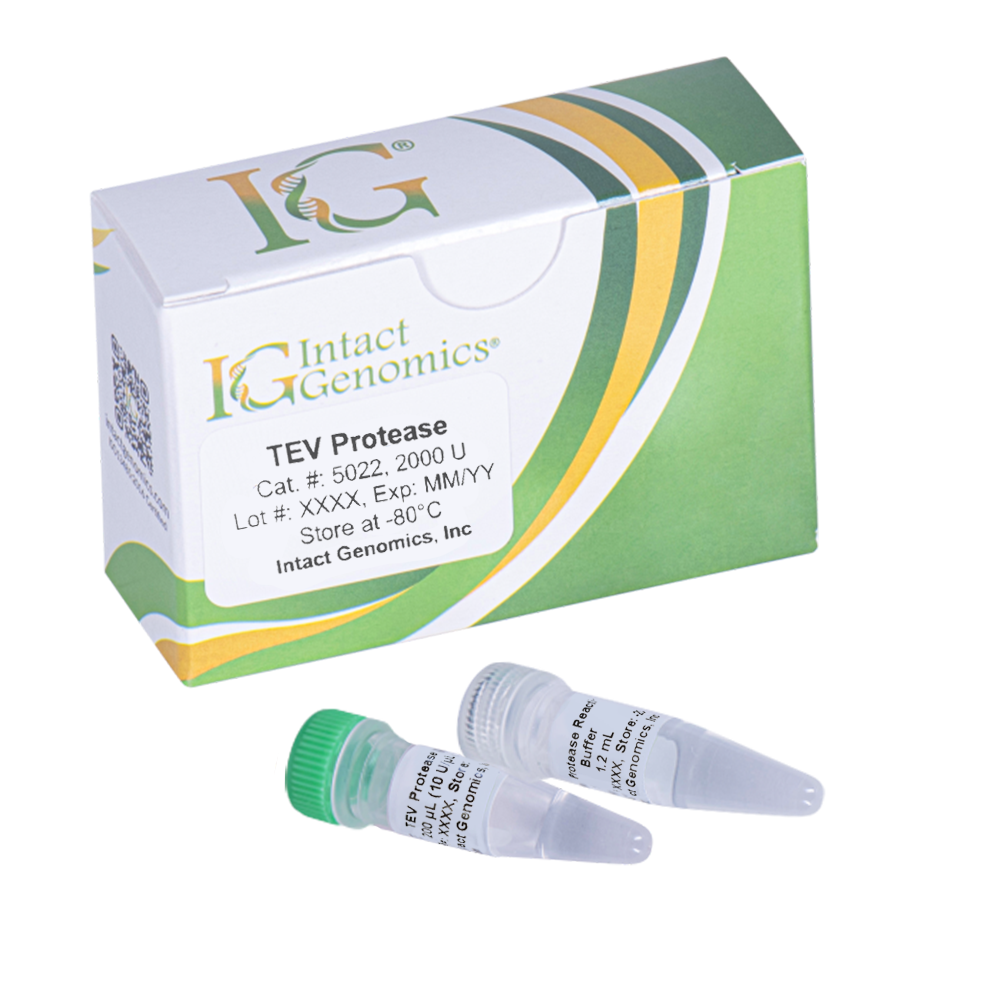
TEV Protease
Achieve clean, efficient affinity-tag removal with IG® TEV Protease. This highly specific recombinant protease precisely cleaves proteins containing a TEV recognition sequence, such as ENLYFQG, while minimizing unwanted proteolysis. Its histidine tag enables easy removal by IMAC after digestion, helping streamline purification and preserve the structure and activity of your target protein.
Custom formats, package sizes and bulk pricing are available upon request.
Price range: $115.00 through $1,875.00
Related products
-

mVenus Fluorescence Standard Kit
$486.00 Select options This product has multiple variants. The options may be chosen on the product page -
DsRed Fluorescence Standard Kit
$485.00 Select options This product has multiple variants. The options may be chosen on the product page -
Biotin Protein Ligase
Price range: $145.00 through $485.00 Select options This product has multiple variants. The options may be chosen on the product page


IG® TEV Protease is a recombinant, highly specific protease used to remove affinity tags from fusion proteins. It recognizes the general sequence E-X-X-Y-X-Q-(S/G) and cleaves between the glutamine and serine or glycine residues. The most commonly used recognition sequence is ENLYFQG.
Derived from the tobacco etch virus (TEV) protease1,2, IG® TEV Protease contains a histidine affinity tag, allowing it to be easily removed from the cleaved target protein by immobilized metal affinity chromatography (IMAC). Its high sequence specificity makes it suitable for affinity-tag removal during recombinant protein purification while minimizing nonspecific cleavage.
Applications:
- Removal of affinity tags from recombinant fusion proteins
- Cleavage of proteins containing TEV recognition sequences, such as ENLYFQG
- Protein purification and downstream processing
- Preparation of native or near-native proteins for structural and functional studies
- Processing of recombinant proteins for biochemical, biophysical, and interaction assays
Benefits:
- Removes affinity tags only from recombinant proteins that have the designed TEV recognition site.
- Will not cleave proteins of interest that have no TEV recognition site in its sequence. The enzyme is highly specific with very limited off-tSpecifically removes affinity tags from proteins containing a TEV recognition site
- High specificity with minimal off-target cleavage
- Helps preserve target protein structure and activity
- Histidine-tagged for easy removal by IMAC
- Suitable for diverse protein purification workflowsarget proteolysis.
- Histidine affinity tag for easy removal after digestion using metal affinity resins.
Product Source:
Recombinant protein derived from tobacco etch virus protease sequence.
Shipping Conditions:
Ship on dry ice or with ice packs.
Specifications:
Activity: 1 unit of TEV protease will digest 2 µg of a fusion protein with a TEV site in 1 hour at 25ºC. Completeness is evaluated by SDS-PAGE.
Components and Storage Temperature:
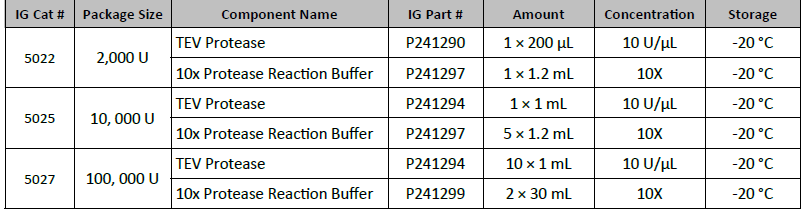
The following reagents are supplied with this product:
Quality Control:
1 unit of TEV protease will digest 2 µg of a fusion protein with a TEV site in 1 hour at 25ºC. Completeness is evaluated by SDS-PAGE.
General Guidelines:
Due to different protein properties, some constructs may require extended incubation periods with TEV protease (up to three days at either 4°C or 30°C) to achieve complete cleavage.
The addition of extra TEV Protease after 24 hours may also help achieve complete cleavage.
Extra TEV protease, up to 5 µL per 50 µL reaction volume, may help with some constructs.
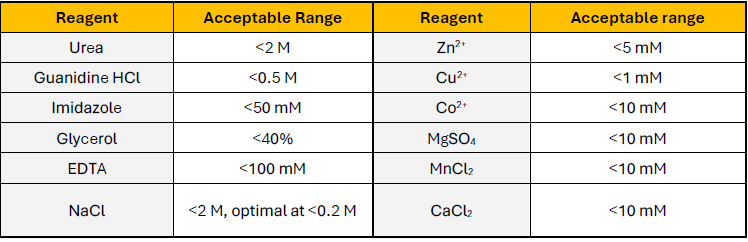
Buffer Compatibility:
References:
- Phan, J. et al. Structural Basis for the Substrate Specificity of Tobacco Etch Virus Protease. Journal of Biological Chemistry 277, 50564–50572 (2002).
- Dougherty, W. G., Carrington, J. C., Cary, S. M. & Parks, T. D. Biochemical and mutational analysis of a plant virus polyprotein cleavage site. EMBO J 7, 1281–1287 (1988).
TEV Protease Reaction Protocol:
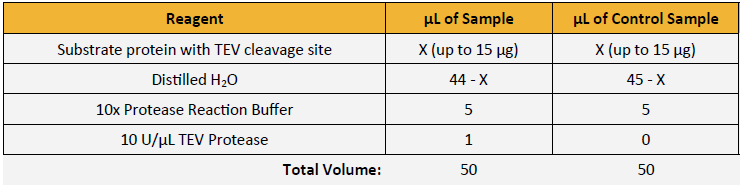
NOTE: Protein constructs may affect the efficiency of TEV protease. Some cleavage reactions may take longer and protease enzyme quantities and reaction volumes may also be adjusted accordingly. For unknown samples, this simple procedure is a good place to start:
-
Set up a sample reaction and a control reaction using the table below:
- Incubate at 30ºC for 1 hour or overnight at 4 °C.
- Analyze cleavage by SDS-PAGE.
TEV Protease Manual
DOWNLOAD
TEV Protease MSDS
DOWNLOAD
Certificate of Origin – TEV Protease
DOWNLOAD
"*" indicates required fields