
Sub-Total: $0.00
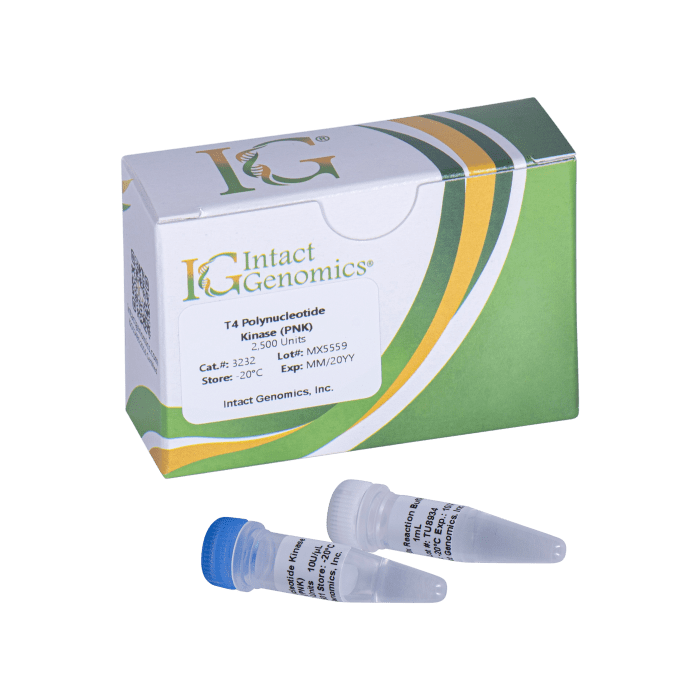
T4 Polynucleotide Kinase (PNK)
T4 Polynucleotide Kinase (PNK) efficiently transfers phosphate groups from ATP to the 5′ ends of DNA and RNA. Ideal for preparing nucleic acids for ligation, it also supports probe labeling, sequencing, cloning, and a wide range of molecular biology workflows.
$191.00
Related products
-

T5 Exonuclease
$245.00 Select options This product has multiple variants. The options may be chosen on the product page -
Tth DNA Ligase
Price range: $82.00 through $395.00 Select options This product has multiple variants. The options may be chosen on the product page -
Exonuclease III
Price range: $120.00 through $205.00 Select options This product has multiple variants. The options may be chosen on the product page -
IG® Lambda Packaging Extract
Price range: $595.00 through $1,975.00 Select options This product has multiple variants. The options may be chosen on the product page -
ig-Fusion™ Cloning Kit
Price range: $227.00 through $1,349.00 Select options This product has multiple variants. The options may be chosen on the product page
Product Description
T4 Polynucleotide Kinase (PNK) catalyzes the transfer of the γ-phosphate from ATP to the 5’-OH group of single- and double-stranded DNAs and RNAs, oligonucleotides or nucleoside 3’-monophosphates. In the presence of ADP, T4 PNK exhibits 5’-phosphatase activity and catalyzes the exchange of phosphate group between 5’-P-oligonucleotides/polynucleotides and ATP (1). The enzyme is also a 3’-phosphatase (2).
The purity of this enzyme is >98% homogeneity as determined by SDS-PAGE using Coomassie® Blue staining.
Product Source
E. coli cells with a cloned pseT gene of bacteriophage T4.
Applications
- Labeling 5′-termini of nucleic acids (3, 4)
- 5′-phosphorylation of oligonucleotides, PCR products, other DNA or RNA prior to ligation.
- Phosphorylation of PCR primers.
- Detection of DNA modification by the [32P]-postlabeling assay (5, 6).
- Removal of 3′-phosphate groups (2).
Includes
- T4 Polynucleotide Kinase (PNK)
- 10X T4 PNK Reaction Buffer
Storage Temperature
–20 °C
Storage Buffer
50 mM Tris-HCl, 50 mM KCl, 1 mM DTT, 0.1 mM EDTA,
50% Glycerol, pH 7.5 @ 25 ºC
10X T4 PNK Reaction Buffer
500 mM Tris-HCl, 100 mM MgCl2, 50 mM dithiothreitol, pH 7.5 @ 25 °C
Note
T4 PNK requires ATP for activity, but it is not supplied with ATP because it interferes with radiolabeling reactions.
Unit Definition
One unit of T4 Polynucleotide Kinase converts 1 nmol of 32P from [γ-32P]-ATP into an acid-insoluble form in 30 minutes at 37 °C under standard assay conditions.
Inhibition and Inactivation
- Inhibitors: metal chelators, phosphate and ammonium ions, KCl and NaCl at a concentration higher than 50 mM.
- Inactivated by heating at 70°C for 15 min or by addition of EDTA.
Quality Control Assays
T4 PNK is tested in 5´ phosphorylation of nucleic acids and is free from exo- and endonuclease and RNase activities.
You must be logged in to post a review.
For Radioactive Labeling
Use 1–50 pmol of 5´ termini in a 50 μl reaction containing 1X T4 PNK reaction buffer, 50 pmol of gamma-[32P] ATP and 20 units of T4 PNK. Incubate at 37 °C for 60 minutes.
For Non-Radioactive Phosphorylation
Use up to 300 pmol of 5´ termini in a 50 μl reaction containing 1X T4 PNK reaction buffer, 1 mM ATP and 10 units of T4 PNK. Incubate at 37 °C for 60 minutes.
References
1. Berkner, K.L., Folk, W.R., Polynucleotide kinase exchange reaction, J. Biol. Chem., 252, 3176-3184, 1977.
2. Richardson, C.C., Bacteriophage T4 polynucleotide kinase, The Enzymes (Boyer, P.D., ed.), 14, 299-314, Academic Press, San Diego, 1981.
3. Sambrook, J., Russell, D.W., Molecular Cloning: A Laboratory Manual, the third edition, Cold Spring Harbor Laboratory Press, Cold Spring Harbor, New York, 2001.
4. Current Protocols in Molecular Biology, vol. 1 (Ausubel, F.M., et al., ed.), John Wiley & Sons, Inc., Brooklyn, New York, 3.10.2-3.10.5, 1994-2004.
5. Phillips, D.H., Detection of DNA modifications by the 32P-postlabelling assay, Mutation Res., 378, 1-12, 1997.
6. Keith, G., Dirheimer, G., Postlabeling: a sensitive method for studying DNA adducts and their role in carcinogenesis, Curr. Opin. Biotechnol. 6, 3-11, 1995.
Reviews
There are no reviews yet.