
Sub-Total: $0.00
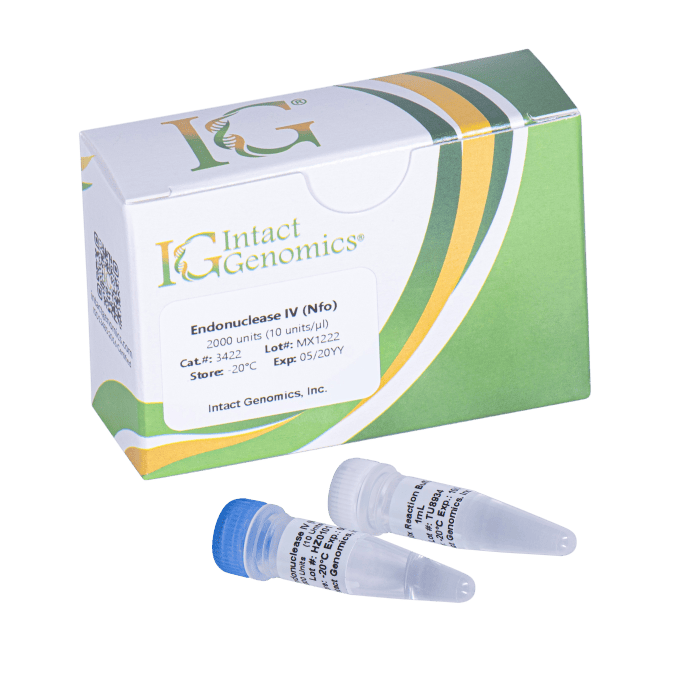
Endonuclease IV (Nfo)
Endonuclease IV (Nfo) from Escherichia coli is a 32-kD metalloprotein that aids in the repair of damaged DNA. The enzyme functions both as an apurinic/apyrimidinic nuclease and as a 3′-terminal di-esterase. Its 3′-terminal di-esterase activity is important in the repair of DNA strand breaks generated by oxidation and ionic radiation. In such events, the strand breaks terminate with either a 3′ phosphate or a deoxyribose fragment, preventing repair by DNA polymerase I or DNA ligase. Endonuclease IV removes the blocking groups, leaving a free 3′-hydroxyl terminus. This enzyme does not have detectable associated exonuclease or DNA N-glycosylase activity.
Price range: $150.00 through $295.00
Related products
-

igSuper™ Tte UvrD Helicase
Price range: $165.00 through $1,250.00 Select options This product has multiple variants. The options may be chosen on the product page -
Bsu DNA Polymerase Large Fragment, Glycerol-Free or Lyophilized
Price range: $85.00 through $410.00 Select options This product has multiple variants. The options may be chosen on the product page -
Tte MutL Protein
Price range: $495.00 through $1,425.00 Select options This product has multiple variants. The options may be chosen on the product page -
T4 UvsX DNA Recombinase, Glycerol-Free or Lyophilized
Price range: $250.00 through $1,420.00 Select options This product has multiple variants. The options may be chosen on the product page -
Sale!
FastAmp® Plant Direct RPA Kit
Price range: $285.00 through $2,255.00 Select options This product has multiple variants. The options may be chosen on the product page
Product Description
Intact Genomics’ Endonuclease IV (Nfo) is a high-purity, 32-kD metalloprotein purified from E. coli that plays a central role in the base excision repair pathway. It works through two distinct enzymatic activities: as an apurinic/apyrimidinic (AP) endonuclease that recognizes and cleaves abasic sites in DNA, and as a 3′-terminal di-esterase that clears blocking chemical groups from damaged DNA ends. The enzyme is highly specific, with no detectable exonuclease or DNA N-glycosylase activity, making it a precise tool for both DNA repair research and isothermal amplification workflows.
How It Works
Oxidative stress and ionizing radiation frequently leave DNA strand breaks capped with a 3′ phosphate or a deoxyribose fragment — chemical “dead ends” that block DNA polymerase I and DNA ligase from completing repair. Endonuclease IV strips away these blocking groups, generating a clean 3′-hydroxyl terminus that downstream repair enzymes can act on directly.
Applications
- Comet assay (single cell gel electrophoresis) — enhances detection of oxidative DNA damage by converting AP sites and damaged termini into scoreable strand breaks
- Alkaline elution assays — supports quantification of DNA strand breaks and damage
- Alkaline unwinding assays — aids in assessing DNA damage and repair kinetics
- RPA (Recombinase Polymerase Amplification) diagnostics — serves as an alternative to Exonuclease III for processing tetrahydrofuran (THF/dSpacer) abasic-site probes in RPA lateral-flow and gel-based detection formats, cleaving the probe at the THF site to generate a new 3′-OH primer site
- DNA damage and repair research — useful anywhere abasic sites or blocked 3′ termini need to be resolved before further enzymatic processing
Benefits
- High specificity — dual AP endonuclease and 3′-diesterase activity with no detectable exonuclease or glycosylase side activity, reducing unwanted background cleavage
- High purity — ≥99% purity by SDS-PAGE with Coomassie blue staining, minimizing contaminating activity in sensitive assays
- Reliable performance — quality-control tested to be free of detectable contaminating nucleases
- Cost-effective — a highly pure enzyme offered at a more accessible price point for labs running routine DNA damage assays or RPA-based diagnostic development
- Ready to use — supplied with 10x reaction buffer, so no separate buffer optimization is needed
Protein purity
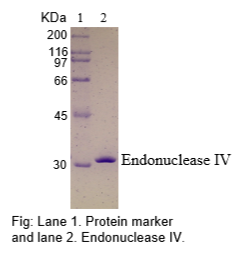
The physical purity of this enzyme is ≥99% as assessed by SDS-PAGE with Coomassie® blue staining (see figure below).
Product Source
E. coli BL21 (DE3) strain expressing E. coli Endonuclease IV gene.
Product Includes
- Endonuclease IV (Nfo)
- 10x Endonuclease IV reaction buffer
1x Endonuclease IV reaction buffer
50 mM Tris-HCl
10 mM MgCl2 1 mM DTT 100 mM KCl (pH 7.9 @ 25°C)
Storage Buffer
50 mM Tris-HCl, 50 mM KCl, 1 mM DTT, 0.1 mM EDTA, 50% Glycerol, pH 7.5 @ 25ºC
Storage Temperature
-20ºC
Heat inactivation
85°C for 20 min
Unit Definition
One unit is defined as the amount of enzyme required to cleave 1 pmol of a 50-mer oligonucleotide duplex containing a single AP site in a total reaction volume of 10 μl in 1 hour at 37°C.
Quality Control assays
Endonuclease IV is free from detectable contaminating nuclease activities.
References
1. Ljungquist, S. (1977) J. Biol. Chem. 252, 2808.
2. Demple, B. et al., (1986) Proc. Natl. Acad. Sci. USA 83, 7731.
3. Levin, J.D. et al., (1988) J. Biol. Chem. 263, 8066.
4. Levin, J.D. et al., (1991) J. Biol. Chem. 266, 22893.
5. Singh, N. et al. (1961). Experimental Cell Research. 175, 184-191.
You must be logged in to post a review.
"*" indicates required fields
Reviews
There are no reviews yet.