
Sub-Total: $0.00
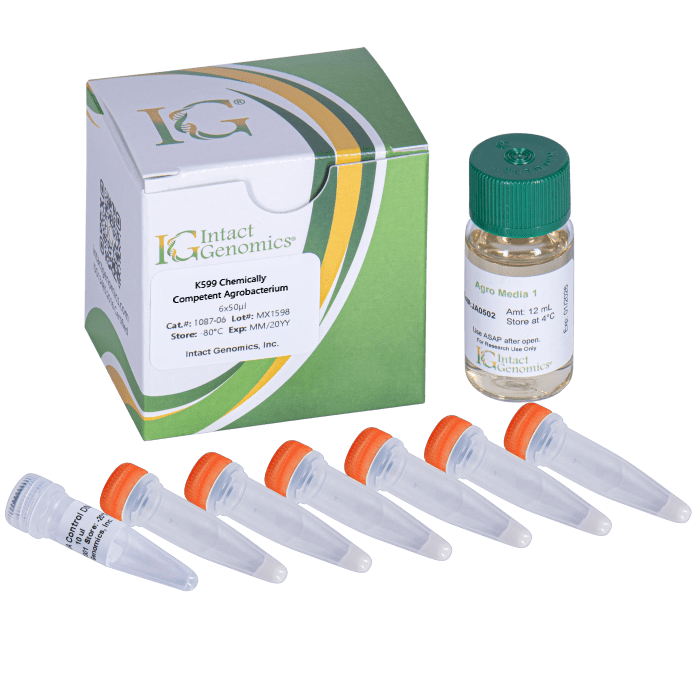
K599 Agrobacterium Chemically Competent Cells
Useful for transgenic operations of corn, soybean (wild soybean), cotton, peanut, dandelion, cowpea and other plants.
Price range: $335.00 through $747.00
Related products
-

Ar.A4 Agrobacterium ElectroCompetent Cells
Price range: $366.00 through $778.00 Select options This product has multiple variants. The options may be chosen on the product page -
MSU440 Agrobacterium ElectroCompetent Cells
Read more -
Ar.A4 Agrobacterium Chemically Competent Cells
Price range: $335.00 through $747.00 Select options This product has multiple variants. The options may be chosen on the product page -
K599 Agrobacterium ElectroCompetent Cells
Price range: $361.00 through $773.00 Select options This product has multiple variants. The options may be chosen on the product page -
ATCC15834 Agrobacterium ElectroCompetent Cells
Price range: $366.00 through $778.00 Select options This product has multiple variants. The options may be chosen on the product page
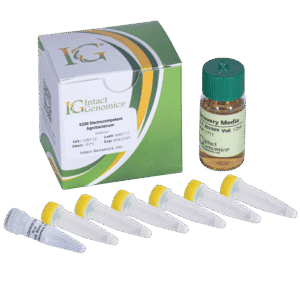
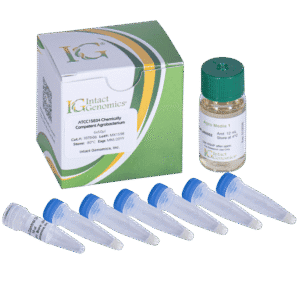
Product Description
Intact Genomics (ig®) K599 Agrobacterium Chemically Competent Cells are made from a specific strain of Agrobacterium rhizogenes, Agrobacterium rhizogenes (str R) pRi2659 (agropine type). K599 was originally isolated from cucumber exhibiting hairy root disease symptoms and has been widely used for hairy root transformation(1).
Agrobacterium rhizogenes is a soil-borne gram-negative bacterium that can infect most dicotyledons, a few monocotyledons and some gymnosperms. K599 Chemically Competent Agrobacterium are optimized for the highest transformation efficiencies and are useful for transgenic operations of corn, soybean (wild soybean), cotton, peanut, dandelion, cowpea and other plants. K599 Agrobacterium rhizogenes strain contains pRi2659 agrobacterium-type Ri plasmid and displays Spectinomycin resistance.
Specifications
Competent cell type: Chemically Competent
Species: A. rhizogenes
Strain: K599
Format: Tubes
Transformation efficiency: ≥ 1 x 10⁴ cfu/µg pCAMBIA1391z DNA
Blue/white screening: No
Shipping condition: Dry ice
Reagents Included
- K599 Agrobacterium Chemically Competent Cells
- DNA (pCAMBIA1391z , 500 pg/µl)
- Recovery medium
Note: Liquid nitrogen is required.
Storage
K599 Agrobacterium Chemically Competent Cells: -80 ºC
pCAMBIA1391z control DNA: -20 ºC
Recovery medium: 4 ºC
Quality Control
Transformation efficiency is tested by using the pCAMBIA1391z control DNA supplied with the kit and using the protocol in this manual. Transformation efficiency should be ≥1 x 10⁴ CFU/µg pCAMBIA1391z Untransformed cells are tested for appropriate antibiotic sensitivity.
General Guidelines
Follow these guidelines when using K599 Agrobacterium Chemically Competent Cells:
- Handle competent cells gently as they are highly sensitive to changes in temperature or mechanical lysis caused by pipetting.
- Thaw competent cells on ice and transform cells immediately following thawing. After adding DNA, mix by tapping the tube gently. Do not mix cells by pipetting or vortexing.
Example Calculation of Transformation Efficiency
Transformation Efficiency (TE) is defined as the number of colony forming units (cfu) produced by transforming 1µg of plasmid into a given volume of competent cells.
TE = Colonies/µg/Plated
Transform 1 µl of (500 pg/µl) pCAMBIA1391z control plasmid into 50 µl of cells, add 950 µl of Recovery Medium. Recover for 3 hours and plate 100 µl. Count the colonies on the plate in two days. If you count 5 colonies, the TE is calculated as follows:
Colonies = 5
µg of DNA = 0.0005
Dilution = 100/1000 = 0.1
TE = 5/.0005/.1 = 1×10⁵
Please note, all agrobacterial strains are not well studied for antibiotic resistance and there are many agrobacterial strains. Therefore, it is the customer’s responsibility to make sure his/her vectors are compatible with the Agrobacterial strains if he/she uses an alternate antibiotic selection than spectinomycin-selection.
References
- Combard, A.; Brevet, J.; Borowski, D.; Cam, K.; Tempé, J. Physical map of the T-DNA region of Agrobacterium rhizogenes strain NCPPB2659.
You must be logged in to post a review.
Transformation Protocol
Use this procedure to transform K599 Chemically Competent Agrobacterium cells. Do not use these cells for electrocompetent transformation.
- Place microcentrifuge tubes on ice.
- Remove competent cells from the -80 °C freezer and thaw completely on wet ice (10-15 minutes).
- Aliquot 1 µl (10 pg – 1 µg) of DNA to the chilled microcentrifuge tubes on ice.
- When the cells are thawed, add 50 µl of cells to each DNA tube on ice and mix gently by tapping 4-5 times. For the pCAMBIA1391z control, add 1 µl of (500 pg/µl) DNA to the 50 µl of cells on ice. Mix well by tapping. Do not pipette up and down or vortex to mix, this can harm cells and decrease transformation efficiency.
- Keep tubes on ice for 5 minutes, and then transfer to liquid nitrogen or dry ice for 5 minutes.
- Incubate tubes for an additional 5 minutes in a 37 °C water bath.
- Immediately add 250 µl of Recovery Medium or any other medium of choice to the tube, pipette up and down three times to re-suspend the cells.
- Incubate tubes at 30 °C for 3 hours at 200 RPM.
- Spread 200 µl cells onto a pre-warmed selective plate. If needed, dilute the cells as appropriate before plating. For the pCAMBIA1391z control, you may plate 100 µl of undiluted transformation mix onto a fresh YT plate containing 50 µg/ml kanamycin only. You can confirm the transformants or colonies by picking and re-plating them on a YT plate containing 15 µg/ml rifampicin and 50 µg/ml kanamycin. Use a sterilized spreader or autoclaved ColiRoller™ plating beads to spread evenly.
- Incubate the plates for 2–3 days at 30 °C.
"*" indicates required fields
Reviews
There are no reviews yet.